I work as an advisor on climate change inclusion in fiction and using creative work as a form of climate activism, with a focus on optimism and hope. I have consulted on climate storytelling for museums, production companies, major brands and publishers.
If you’d like to enquire about opportunies to collaborate, email me at wrenjameswriter@gmail.com. I would be particularly interested in work on existing TV series as a climate-focussed script editor.
Previous work:
- I founded the Climate Fiction Writers League, a network of 300+ traditionally published climate fiction writers. I work with authors to create essays for the substack.
- I created The Climate-Conscious Writers Handbook, an interactive, playful journal aimed at helping storytellers create more positive climate fiction.
- I was on the sustainability committee for the Society of Authors, developing their Tree to Me campaign
- I’m on the advisory board for the Climate Fiction Prize
- I worked with the Good Hero production company on story development for ‘Earthkeepers’.
- I wrote an essay ‘Writing Hopeful Climate Fiction’ for the Children’s Writers’ & Artists’ Yearbook 2023
- I worked as a story consultant on Netflix’s Heartstopper, adding climate change references into the background of the story.
- I edited the anthology Future Hopes: Hopeful stories in a time of climate change for Walker Books, helping authors to weave climate themes into their stories.
- I worked with Pernod Ricard on their 2050 Futures scenarios.
- I worked with Oxford’s The Story Museum on their climate exhibition.
Watch my talks
- I gave a workshop to the Society of Authors on climate fiction, which you can watch on Vimeo.
- I appeared on a panel at the BBC’s Climate Creatives Conference 2024, which you can watch here.
- I gave a lecture at the Mirrors or Movers X Conference 2023 at the BBC centre, available on Youtube.
Academic Papers Citing my Climate Activism
The Dark Matter of Children’s ‘Fantastika’ Literature by Chloe Germaine
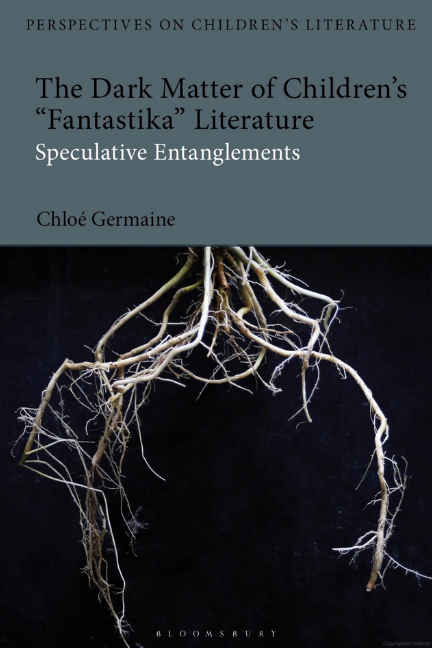
Following the ‘material turn’ in the humanities, this book brings perspectives from science and ecology into dialogue with children’s fiction written and published in the UK and the USA in the 21st century. It develops the concept of ‘entanglement’, which originated in 20th century quantum physics but has been applied to cultural critique, through a reading of Fantastika literature. It surveys a wide-raging scope of literary texts, covering the gothic, fantasy and other forms of speculative fiction, to argue that Fantastika positions entanglemet as an ethical imperative that transforms our imaginative relationship with materiality. In doing so, it synthesizes perspectives from a similarly diverse range of areas, including ecology, physics, anthropology, biology and literary studies to examine the storied matter of children’s Fantastika as ground from which we might to begin to imagine an as-yet-unrealised future that addresses the problems of our present.
Narrative identity, or the construction of a coherent life story to shape a sense of self, is a crucial aspect of identity formation. Narrative identity is impacted by the prevailing cultural narratives during the period of adolescence. This article, drawing on theory from literary studies and sociology, explores the impact of cultural narratives of environmental crisis and destruction on an emerging narrative identity in adolescents as represented in young adult literature. The selected novels—Dry by Neal and Jarrod Shusterman, Green Rising by Lauren James, and Snowflake, AZ by Marcus Sedgwick—examine their protagonists’ agency and transformational potential. They foreground collective agency and human–nonhuman assemblages as possible responses to environmental crisis. Although two novels (Dry, Green Rising) affirm that narratives of environmental destruction engage the transformational potential of adolescents for society, the third novel (Snowflake, AZ) complicates this image and questions whether the impact of narratives of environmental crisis could be too overwhelming for adolescents to bear. The article concludes that the young adolescent protagonists adapt their narrative identity in response to environmental destruction.
Writing Ecofiction: Navigating the Challenges of Environmental Narrative by Kevan Manwaring
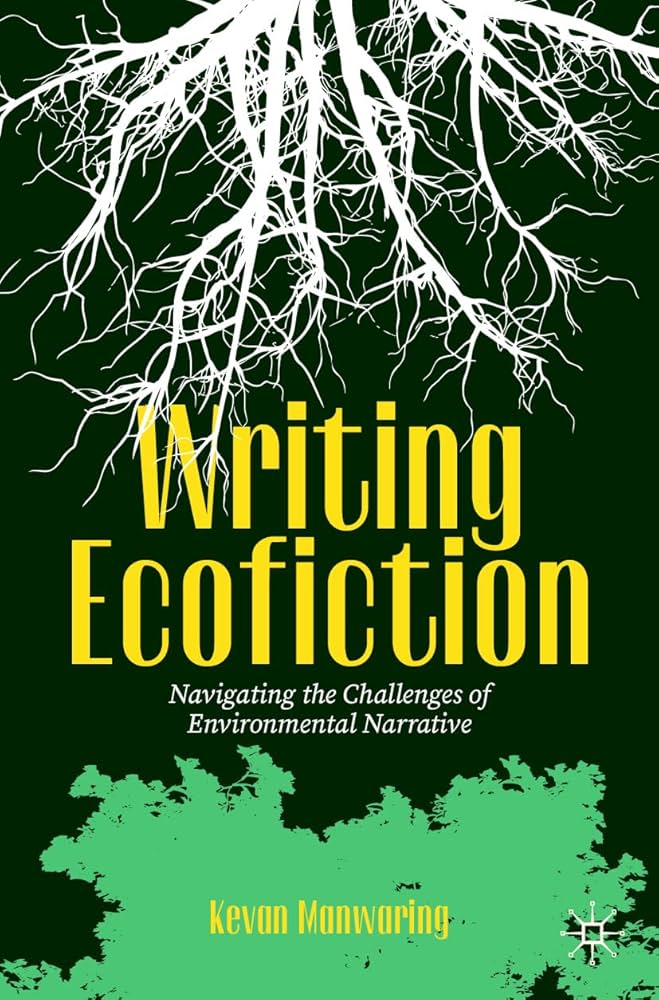
The Climate Fiction Writers League founded by former physicist Wren James (author of the 2021 YA ecofiction, Green Rising, and others) eschew a precise definition of ‘Climate Fiction’, but emphasise the need to create positive, empowering narratives to inspire readers:
The climate debate needs to move beyond fear at rising sea levels and pollution towards a more solutions-based view on climate change. I feel strongly that we should not be telling a generation of children that their future is unavoidably broken. Change is possible. The climate crisis is an urgent, yet utterly solvable issue. Our fiction should reflect that.
We all die at the end: Storytelling in the climate apocalypse by Sam Haddow
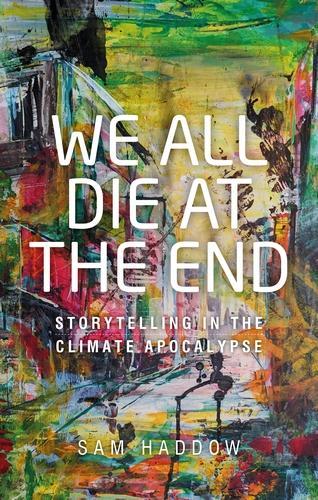
An alternative take on the castaway is offered in Lauren James’s young- adult novel The Quiet at the End of the World (2019). This concerns two teenagers, Lowrie Mount- Batten Windsor and Shen Zhang, the last humans born from frozen ova seventy years after the entire human population was sterilised by a pandemic in the
early 2020s. They live in an otherwise abandoned and collapsing London, cared for by a community of 300 septuagenarians who are the last people on earth. As the novel progresses, the pair discover the social media account of a woman who lived through the pandemic and realise that their elders are not human but are in fact [….]This openheartedness chimes with the novel’s support of trans rights, which it quietly develops in a parallel narrative of the last generation of humans, documented through a salvaged hard drive containing old social media accounts. The
blurring of gender binaries is itself a critical element of certain contemporary end- of- the- world fictions.[….]
A curious addition to the growing corpus of fungal fictions is Lauren James’s Green Rising (2021). This young- adult novel is set in an alternative universe where children and teenagers start to magically grow plants from their skin. One of the protagonists, a working- class English- Bangladeshi boy named Theo, finds that he can grow mushrooms instead, connecting to a mycelial network that links all young people who have developed this ‘greenfingers’ power. It is essentially a wistful eco- daydream, in which a group of these superheroes band together to take on an evil oil company and in the process restore the planet’s broken eco- systems. A melancholy utopia, attainable only by magic. Significantly, though, the novel is driven by an angry critique of the so- called ‘longtermist’ philosophy favoured by contemporary billionaires and draws a line
in the sand that embraces fungal systems that elsewhere, in more serious grown-up literature, are often the cause for terror.
The Routledge Handbook of Grassroots Climate Activism
Chapter ‘Grassroots Climate Activism Across Six Continents‘
Responding to the “unprecedented, catastrophic flooding” that devastated local communities in the town of Lismore in 2022 in the biggest modern flood disaster in Australian history, Nicole Rogers writes that [a]ll academics, and not only the academics of a university already experiencing the ravages of climate change, have an overriding obligation to be climate activists. There is no possible justification for neutrality, dissembling or prevarication in light of what we know, and have experienced, at 1.1 degrees of global warming. Animated by her impassioned appeal, this “undisciplined” handbook sets out to examine grassroots climate activism as a crucial feature of an epoch of perilous human-environmental crises. It starts from three primary questions: what does grassroots climate activism – or taking action on climate change – look like in different parts of the world and in different political, economic, cultural, and institutional contexts? How can it be studied in “undisciplined” ways – without the restraints of disciplinary boundaries, and by giving space to nuance, dilemma, and critical analysis – while remaining sensitive to the phenomenal urgency of climate breakdown? And in what ways can a handbook such as this serve as a prompt for others to get involved in tackling the climate crisis, in the circumstances of their own lives, and using the repertoires of action available to them?
Climate Fiction: Youth as Catalysts of Change by Michaela Bouzková
One standout example of climate fiction, this thesis will be focusing on the most, that resonates with both the young and the young-at-heart is Green Rising (2021) by Lauren James, because not only it explores the dire consequences of global warming but also offers a vision of hope, showing how young people, those most impacted by the changes happening today, can lead the charge in creating solutions.
Climate fiction has the ability to translate complex environmental issues into compelling, human-centered stories, which can resonate better with the audience, especially the younger readers, who sometimes may not fully understand the scientific researches regarding these issues. That is why, the importance of cli-fi is much bigger than can be expected. Green Rising is particularly effective in this regard, using its fictional framework to illustrate the real-world importance of climate action. As the world faces increasing environmental degradation, youth-led movements like Fridays for Future have shown that the younger generation is not only most affected by climate change but also the most vocal in demanding change. Through books like Green Rising, young people can see themselves as important individuals with the power to shape the future through collective action, imagination, and determination.
Green Rising is about politics, standing up for what individuals believe in and taking direct action. This fiction was inspired by movements like Extinction Rebellion, a movement that aims to mobilise large numbers of people, to work with other climate and environmental groups, achieve a wide spectrum of support across society, and to persuade governments to act justly on the climate and ecological emergency. With this in mind, Lauren James presents a world where plants have evolved to absorb carbon from the atmosphere, providing a way to reverse the damage of climate change. This premise, while fictional, taps into the real world possibilities of bioengineering and reforestation as means of mitigating climate damage.
The story also presents situations similar to the present world, such as the oil drilling rigs in the North Sea, which contribute greatly to the water pollution as the following example illustrates:
‘The energy company had built a new oil drilling rig right in the middle of the North Sea where Theo’s dad normally fished. The hulking orange platform damned bilge water into the ocean as they proceeded oil, covering the seabed in chemicals and dirty sediment.’
Transmodern Literatures in the 21st Century: Of(f) Limits
Chapter ‘Special Relativity, Real-Time Communications and Vulnerability in Outer Space and Lauren James’s The Loneliest Girl in the Universe‘ by Jessica Aliaga-Lavrijsen
In her recent feminist science-fiction novel The Loneliest Girl in the Universe (2017), Lauren James tackles topics such as the impact of the supremacy of technology in the realm of human communication in Transmodernity and space travel, as well as the transmissibility of digital information and what Rodríguez Magda has termed “static connectivity” (2004 and 2011)—which refers to new forms of relation and online interactions in which individuals relate to others without completely leaving their isolation. Furthermore, the novel’s innovative generic features—a space opera combining emails, fan fiction, diary entries as well as more traditional narration—invite readers to reflect both on the nature of delayed and instantaneous communication, as well as on the subjective nature of space-time in interstellar space travel, which inevitably transgresses our conventional spatial and temporal humanly limits. The homodiegetic narrator and focaliser of the story, a teenage girl, is traveling beyond humanly limits, as she is exploring a reality never experienced by any human being before, which leaves her with a deep feeling of disconnection and loneliness, as suggested by the novel’s title. As the analysis of the novel will show, despite universal longing for communication and connection, truth and real communication can be obscured even more by the mediation of technology, as it is not immune to the workings of power relationships. As the story reveals, it becomes clear that instantaneity, or the transmissibility of information in real time, is not the outcome of the creation of an ideal and global democratic network in which all the parts have equal power. Moreover, vulnerability is one of the key characteristics of the transmodern human who is trying to find a new planet in which future life could thrive. In short, James’s feminist approach to all these topics reveals that “static connectivity” cannot overlook the vulnerability present in all forms of relationality, and that gender relationships and equality are still issues to be considered and to be fought for.
Humanity and Contemporary Post-Apocalyptic Imagination in the Work of M. R. Carey and Lauren James by Trang Dang
The human and the nonhuman are deeply and essentially intertwined.
This intertwinement is an underlying theme in The Quiet at the End of the World, serving as a catalyst for the novel’s primary focus on, and exploration of, the relationship between humans and technology that will be discussed in this section. James begins her novel with a phone call between Maya Waverley and the ambulance service about her mother’s unstoppable nosebleed, and with the service’s operator hanging up on her, for this person, too, starts having an uncontrollable nosebleed. It turns out that the nosebleed, which soon becomes widespread just like the pathogen in The Girl with All the Gifts, is a symptom of a virus of unknown origin. If Swanson et al. see figures of monsters as signifying the wonders of symbiosis, in the 2020 STRP Festival that centres around the socio-biological implications of Covid-19, Timothy Morton (2020) titles their essay
‘Thank Virus for Symbiosis.’ In another context, they remark that viruses show us the porosity of lifeforms, how these lifeforms ‘are made of other lifeforms’ (Morton 2013: 29). The mention of the unidentifiable virus in James’s text, then, calls attention to the symbiotic relationship between the human and the nonhuman.Experiencing a nosebleed herself, Maya shares on her social media that one day, she cannot ‘stop showering and showering, trying to get the virus off [her]’: ‘I know that’s not how it works, but it helps’ (James 2019: 53). Yet this admission contradicts what she puts immediately after: I ‘scrub at my face until it feels tender, gargle mouthfuls of soap, and spit it out in the drain. I still feel infected, like the virus is all over me’ (James 2019: 53). Maya’s attempt to separate her (the human) from the virus (the nonhuman) fails because such a separation is impossible. As discussed above, humans are constituted by a host of bacteria and nonhuman DNA without which they cannot survive. Maya cannot wash off the nonhuman that is ‘all over [her],’ because it is part of her, in other words, it is what makes her human. Like any other lifeform, she is perforated and vulnerable to disease and infection because she is directly connected to beings and elements that are not uniquely hers.
This study explores the Young Adult (YA) genre focusing on the novels of Lauren James. Young Adult novels are often dismissed as being a lesser form of literature, the genre typically ranked lower by critics and the general public as less serious fiction. This study aspires to explore the complex issues that the genre creates a platform for, discussing the progressive nature of the narrative that inspires social and moral values in young readers.
The exploration of these ideas will focus on James novels; The Next Together, The Last Beginning, The Loneliest Girl in the Universe and The Quiet at the End of the World. The young adult genre has unique place in literature, exploring themes that are progressive and crucial for the development of moral and social beliefs in their readership. Using Lauren James’ novels as a case study, this dissertation aspires to provide evidence of the complexity of ideas explored within the genre.
In addition chapter one will focus on the significance of women in scientific roles in James’ novels, providing examples of female characters who serve as standout role models for young readers, striving to achieve the goal of normalising women in roles traditionally occupied by men.
In line with her feminist ideals, subverting gender stereotypes is a continuous feature of James novels, further evidence which will be discussed in relationship to James’ thoughts on writing for young women. To accompany this discussion, chapter one will feature thoughts from secondary sources in order to provide a wider post-feminist context, supported by sources from Rosalind Gill and Natasha Walter; providing further insight into the significance of a feminist identity in modern society.
Chapter two will explore YA fiction and the LGBTQ+ community, citing critics including Michael Cart, exploring YA fiction and sexuality, introducing a symbiotic pairing that highlights the importance of the YA genre for LGBTQ+ readers. This chapter will argue for the importance of inclusion and diversity in YA novels specifically, tracing the change of attitudes and representation of sexuality. I will provide evidence of James’ strong beliefs on the subject of inclusion and discuss the progressive nature of her novels.
Countering eco-anxiety through young adult climate fiction: Lauren James’s Green Rising by Chiara Xausa
This paper will propose a close reading of Lauren James’s recent YA novel Green Rising (2021), a timing story centered around a climate-change activist (Gabrielle), who develops the ability to grow plants from her skin; her story is entangled with that of other teenagers around the world who develop this strange new “Greenfingers” power. My analysis will explore how emotions (personal experiences) and affects (the forces that precede, produce, and inform such experiences) function in environmentally oriented texts for young adults. I will use affective ecocriticism to evaluate the literary structures and devices through which such narratives convey environmental understanding and become engines of affect, stressing that emotional responses are evoked as readers empathize with characters, while also inhabiting emotionally the storyworlds that surround such characters. A particular attention will be devoted to the entanglement between negative/painful emotions (e.g. ecogrief, climate anxiety, solastalgia) and positive emotions (empathy towards victims of environmental injustice and towards the nonhuman, hope that can emerge from grassroot activism, the spontaneous collectives and moments of solidarity that can arise out of disasters [Solnit 2009], and altruistic emotions that can activate trajectories of change). Contending that pedagogy does not have to follow an arc of hope in order to prevent despair (Ray 2020), I will consider the genre of YA dystopia as privileged site of investigation to explore the importance of cultivating both positive and negative emotions, as it deals with dark times but maintains the potential to inspire the ‘social dreaming’ that is central to utopia, challenging and disturbing young readers (Baccolini 2019). The overall aim of this paper is to investigate the role of YA cli-fi in helping young readers to cope with the negative emotions emerging in the Anthropocene, and to turn climate anxiety into critical thinking.
The novel Green Rising by Lauren James as diadactic climate fiction by Dejan J. DURIĆ (in Croatian)
The paper examines Lauren James’ novel Green Rising (2021) through the genre prism of climate fiction intended for children and young people, especially its variant – didactic cli-fi. In this way, the adventure plot is intertwined with social activism and the educational and upbringing function of raising awareness of anthropogenic influences on the escalation of climate change and the necessity of transforming social consciousness. The novel, like most climate fiction, is based on recent scientific indicators, and at the same time combines various genre strategies (science fiction, adventure novel, romance novel) with currently particularly topical superhero narratives, in order to express the necessity of ecological activism and the social struggle against aggressive corporatism and capitalism, which prioritize money over the benefits of the planet and life on it.
 Wren James