The best advice I’ve been given as a writer always comes from my agent. She reads my first drafts in their truly terrible initial form. Every time she identifies a key weakness in my writing, whether that’s making sure each scene serves a purpose, varying my sentence structure more imaginatively, or avoiding describing all of the physical movements my characters make. These pieces of advice become keystones as I edit and draft new stories.
The advice that’s stuck with me the most is to ensure that readers feel empathy for my characters. If they aren’t invested in the protagonist, then even the most exciting action scenes with dangerous high-risk stakes are going to feel meaningless.
Characters need to be three-dimensional, engaging and human. By the end of the first chapter, we should understand what kind of person they are, what they want, and what they need.
Draw from real life. Not by stealing someone’s personality wholesale, but by taking pieces here and there – your mother’s worst fear, your best friend’s guilty secret, or your co-worker’s annoying habit.
You are searching for the emotional truth behind these quirks – what does this reveal about this person? The fact that your mother is afraid of scam calls isn’t because she’s scared of the ringing landline. It could be because she has been tricked and taken in by fraud in the past, and is terrified of letting that happen again. She is aware of her own gullibility.
By seeding in this one small detail, you lay the groundwork for a whole novel’s worth of character development. You are showing that the character has a complex inner life beyond what is necessary for the action. This builds out from the core storyline to create a world that feels fully inhabited by real people, not just paper cut-outs being moving around where the author guides them.
Remember, the details of specific incidents are less important than finding out what that means for the character. We don’t need to know the specifics of the scam that the side character fell for, but knowing that they did fall for it tells us a lot about them as a person.
The quickest way to alienate a reader is to have a character who makes poor decisions without explaining why they do those things. Even a reckless character needs to react in ways which feel plausible.
We want to see them work hard, and fail. If success comes too easily for them, then we won’t feel satisfaction. Events should have consequences, so that we feel emotionally invested. You could have a very complicated fantasy world, with an intricate magic system, but it won’t mean anything unless we understand the cost of using magic, emotionally or physically.
Think about what your characters fear, love and keep secret. Are they a hero or a villain? Who do they trust? What makes them laugh? What makes them wince? If they have a love interest, is their mutual attraction based in real, long-term factors of connection and compatibility?
Write a person, and the rest becomes easy. Once we’re invested in their personal journey, the plot can take us anywhere and we’ll happily tag along for the ride.
Dianna Wynne Jones. Lois McMaster Bujold. Susannah Clarke. Madeline Miller. Mary Robinette Kowal. N. K. Jemisin. Naomi Novik. Becky Chambers. Ursula K Le Guin. Just a few of the female authors of science fiction and fantasy who’ve crafted the genre into what it is today.
Science fiction has been sculpted by women, from Margaret Cavendish’s early Utopian novel The Blazing-World, written in 1666, to Mary Shelley’s Frankenstein from 1818, all the way to Verity Lambert’s work as the founding producer on Doctor Who in 1963.
I have a fascination with female creativity, especially when it interrogates personhood and identity through the lens of fantasy. In The Blazing World, Cavendish created a utopian world, accessible through the North Pole, where the female protagonist had the freedom to behave as she wished without social division. The writer was imagining a better world, where being a woman didn’t restrict the choices she could make – something that truly would have seemed fantastical in the seventeenth century.
In Frankenstein, Shelley examined human nature through the creation of a living creature. She used this fantastical guise to interrogate how society treats someone whose existence falls outside the bounds of acceptable behaviour.
Women have been using art to explore their place in the world for millennia. Some of the earliest forms of artistic sculpture are the Venus figurines, which have been unearthed across Europe. Over two hundred stone carvings of female bodies have been found, usually around thirty thousand years old, though sometimes over half a million years old.
These beguiling sculptures have distorted body shapes; with exaggerated, distended torsos and a noticeable lack of arms, legs, or faces. Often painted with ochre to match skin tones, and carved with plaits of hair, it’s believed that they were sculpted by women looking down at their own bodies and trying to recreate what they saw.
However uncanny and disorientating they may be, there’s something irresistibly charming about the misshapen figurines. Their commonness implies that hundreds of thousands of years ago, women cared about who they were as individuals. They lived in a society where that mattered; where their identity and appearance affected their social interactions. They took the time to study their own bodies because they wanted to compare themselves to the people they knew. They were constructing their own self-images. Chipping away at their identities, one flake of stone at a time.
So much of women’s voices and interiority is lost from the history we are told of humanity, but from the earliest days, female creativity has been a driving force in culture. Women have left records of themselves in any way that they can. Innovation and art is tied to womanhood in a way that can’t be separated, from sculpture, to creating the novel form in Japan one thousand years ago, to writing the earliest science fiction novels.
In The Blazing World, Margaret Cavendish was asking some of the same questions as the woman who carved the Venus of Willendorf. Who am I? Do I matter? How do I fit into the society around me? How does my appearance and gender change the way I’m treated?
Modern science fiction writers continue to ask those questions. In the 2015 Broken Earth trilogy – which set records by winning ‘Best Novel’ at the Hugo Awards for each novel in the series – N. K. Jemisin masterfully imagines a far-future society where repeated apocalyptic events have wiped out most human knowledge. This has created a world with little sexism, where the female characters are unimpeded by their gender.
The Broken Earth trilogy asks the same question raised in Frankenstein: what elements of human behaviour are social constructs which must be taught to new generations? And what would a world look like without our society’s worst negative traits?
In the sprawling Vorkosigan Saga, which Lois McMaster Bujold has been writing since 1986, a different kind of future is created. Here, society has reverted to a medieval state which keeps women under tight control. In a high-tech, far-future setting, where humans have colonised the galaxy, one planet is cut off from the universe. It devolves into a feudalistic world with incredibly backwards social norms. If The Blazing World invented a magical utopia for women, then this is quite the opposite.
The people on the isolated planet have no understanding of another way of life. When they reconnect with the rest of the galaxy, their feminist, liberal politics shatter their cultural beliefs.
In Susannah Clarke’s 2020 novel Piranesi, which won the Women’s prize for fiction, a man with no memory lives alone in a flooded labyrinth of halls. He keeps a diary of the knowledge he has gathered about his small world, as he carves out an understanding of who he might be. He doesn’t have any concept of his own personhood, because he has no society to reflect his image back at him.
Victor Frankenstein warned, “Learn from me, if not by my precepts, at least by my example, how dangerous is the acquirement of knowledge, and how much happier that man is who believes his native town to be the world, than he who aspires to become greater than his nature will allow.”
Knowledge of the world changes the way it is experienced. What is science fiction if not a vehicle to examine the world we live in, and ask: how would I be different if I lived somewhere else? On a spaceship in the future; in a world hidden at the North Pole; in a flooded vestibule? And how can I create that desired world, in fiction and in real life?
As a writer, my science fiction centres the female experience. I’ve been writing since I was sixteen, and over time my ideas, personal identity and desires have evolved. The worlds I create reflect this, whether consciously or not. Writing is a cathartic, intimate process – for genre fiction as much as memoir or poetry.
For me, reading science fiction by the great female minds of the genre feels like coming home. It tells me: you’re safe here. Your experiences are valued. And the worlds we’ve created together will have a place for you. Always.
Arthur C Clarke once said that, “Any sufficiently advanced technology is indistinguishable from magic.”
As a science fiction writer, I can confirm that this is true. Most of my story ideas come from intriguing scientific theories which have caught my attention. Whether that’s a hypothesis for how time travel might be feasible using black holes, or a test of sentience on Artificial Intelligences. So much inspiration for science fiction can be found in science fact.
But in that slippery, transmutable way that inspiration often has, my ideas switch up on me. My carefully researched science often transforms into magic during the writing process.
When a story is set in the far-future, technology is so distinct from our current capabilities that it might as well be wizardry. We can’t create cryogenic chambers for space travel any more easily than we could cast an age-freezing enchantment.
In Jurassic Park, dinosaurs are brought back from extinction using samples of blood taken from ancient mosquitos trapped in amber. Of course, this is impossible. It’s nothing more than loosely justified necromancy. But there’s a logic behind it, that we can almost believe in. Enough to suspend our disbelief, sit back and enjoy the story.
In the same way, well-constructed fictional magic systems have logic behind their mystique. Magic requires an input of energy (blood, a firstborn child, a true name). There’s a technical process (a spell, a ritual, a potion) which exerts a force (an enchantment, a transformation, a curse).
A witch stirring newt guts into a cauldron to create a homunculus is indistinguishable from a programmer encoding an algorithm to create a sentient robot. Neither exists in the real world, so on the page it’s absolutely crucial for both processes to be believable.
In The Glamourist Histories by Mary Robinette Kowal, magic users can manipulate light to create glamours of colour in the air. The magic is informed by the real behaviour of light, which limits what the characters can do. However, the author’s commitment to the laws of physics also leads in surprising directions. The light glamours are used in medicine, since ultra-violet light can be used to sterilise wounds.
It can be tempting to justify the rules of your magic with real science, but you can’t explain everything – and you shouldn’t try. Some things are better left mysterious to avoid bogging down the story with unnecessary exposition. As the creator, I have to research the science behind my fictional time machines, robots and spaceships, but only so I know how much I can get away with. As long as I don’t break the thread of logic, the reader will trust that it works. The theorem doesn’t need to be proven. Sorcery can be left to the imagination.
The best fiction exists in that fuzzy boundary between magic and science. Star Wars is a science fiction universe, but the Jedi lightsabers are pure magic. In His Dark Materials, a world of witches and talking polar bears has a plot which hinges on real life dark matter and physics.
This intersection of seemingly conflicting areas of study has always enraptured me. In my novel The Reckless Afterlife of Harriet Stoker, a community of immortal ghosts exist according to strict laws of energy conservation and physics. Ghosts use their own life force to cast spells. Once their energy is used up, they disintegrate.
For every action in nature, there is an equal and opposite reaction. Power has side effects. Whether we call it nuclear energy or magic, it still takes resources from the environment. It will pollute or destroy natural resources. It will have ethical and moral implications, like genetic modification or pesticides in real life.
Power is always a valuable commodity in society. Just as technology can be easily attainable, or rare and inaccessible, so can magic. Resources can be hoarded by a magician in their tower, or a billionaire on Twitter. It can be every-day and unremarkable, like flicking on a light switch, or world-ending, like setting off a bomb.
Characters can be born with a natural gift for algebra or alchemy, or – more interestingly – they can struggle to learn their skills the hard way. Whether they use a tablet or a wand, the writer can make them work for what they need.
In my novel Green Rising, a mutation in teenagers makes magical plants grow from their skin. I was inspired by the fungal network that links the roots of trees – the ‘wood wide web’ – and allows plants to communicate.
My teen characters use their plant magic to build a network of people fighting to slow climate change. The grassroots activists connect together to reforest the world, committing acts of civil disobedience which unearth the status quo. Their magic has some downsides – it sucks nutrients from their bone marrow – but it gives them the power to create change.
Magic is a political tool, changing society in the same way that technical innovations can create revolution. Like, electricity, cars, and the internet, magic is morally neutral. But it can be wielded for good, evil, or something in-between.
In Green Rising, magic is wielded scientifically to rewild the Earth. In my novel The Quiet at the End of the World, I did the opposite. I used science to cast a magical spell. At the beginning of the story, humans are made sterile by a global pandemic. Desperate to avoid extinction, the last generation works together to create AI offspring which are functionally human in everything but biology. After time, the origin of these computer-coded children is forgotten. They are human, no different from the generations that came before them. The magic spell which created them is lost to time.
A nuclear waste storage site will turn into a mysterious glowing cave, given enough time. Science becomes magic with distance. Only our understanding of the process changes its definition.
Arthur C Clarke told us that sufficiently advanced technology is indistinguishable from magic. But in the hands of a writer, all magic has the potential to become technology. And politics. And ethics. And economics. And character development. Magic is the perfect vehicle for storytelling. It’s whatever we need it to be.
During the summer holidays at the age of sixteen, I spent a heavenly six weeks grinding freeze-dried honeybees into powder in one of Warwick University’s science labs. I’d captured the bees myself, bedecked in a white suit and mask, from a local beekeeper’s wildflower meadow hives.
Once they were thoroughly decimated with a pestle and mortar, the powdered insects were poured into vials so their DNA could be extracted. I wanted to track down the honeybees’ origins. Not their recent Warwickshire origins, but their deep-time, historic ancestry.
Cells are time capsules. In every cell of every creature, there’s a remnant of leftover DNA in the mitochondria. This is an archaic artefact of evolution – the mitochondria was once its own living organism, which was engulfed by a larger cell back in times of prehistory.
Unlike typical DNA chains, which are mixed and matched each generation to take sequences from both parents, the mitochondria’s DNA is fixed. It stays the same between mother and offspring, generation after generation.
A honeybee today has the same mitochondrial DNA as one living ten thousand years ago. Except for a few little mutations here and there, which spring up at random, and are passed on to the next generation.
These mutations in sequencing are very useful for tracking where honeybees have come from. If a bee in Croatia and a bee in Derby have the same mutation – an A swapped to a G, or a C swapped to a T – then at some point in their history, those two bees had a common ancestor. This lets us create a family tree of bee populations throughout time, stretching as far back as the earliest honey queen, the biblical Eve of bees.
I wanted to work on the honeybee project – despite the macabre bee-killing I’d have to endure – because I’ve always been interested in communications across time. It’s harder than you might think to decode messages from the past. Often the DNA inside our cells is easier to understand than an actual message left by a living, breathing human being.
Hidden in the darkness of caves across Europe are masterpieces of ice age art, which have survived for tens of thousands of years. These enigmatic drawings of horses, deer and mammoths remain mysterious, even after decades of study. It was only early in 2023 that an amateur detective decoded some of the markings carved into the rock. The parallel lines etched next to different animal drawings are now through to be calendars showing the number of months after spring in which each species gave birth.
We don’t understand most of the messages left by those long-dead artists, but we could easily sequence their mitochondrial DNA from a bone fragment to determine which of the ‘daughters of Eve’ they descended from, tracking their lineage back to our most recent common ancestor, who lived in the earliest human tribes some two hundred thousand years ago.
I’ve always loved the idea of having an undisturbed time capsule hidden inside my cells. A message inherited from that early ‘Eve’. It was the inspiration for an early story of mine, written when I was undertaking my honeybee detective work.
Science has always been linked to my creative writing. Inspired by my research into ancestry, I wrote The Quiet at the End of the World about aglobal pandemic which makes humans infertile. The last generation is devastated by the knowledge that the human race is going to go extinct. As their cities and skyscrapers start to empty, the endlings must decide what kinds of time capsules they want to leave behind for the future, like that early Eve’s mitochondrial DNA.
Humans have carved our place on Earth’s surface, from ice age art to the ridges and furrows left by ancient farming. A layer of plastic fossilised in the rock. A significant quantity of Coca-Cola-branded litter and carbon dioxide in the atmosphere.
Our legacy is often not something to be proud of, which is part of what makes it so compelling to write about. How do you write a story about humanity which encompasses everything we’ve done to this planet, in a way that showcases the best of us rather than the worst?
It’s possible that if we did go extinct, there would one day be another species which evolved to become sentient enough to examine our remains. Octopi, corvids and dolphins are all highly intelligent in their own ways. To those future interspecies archaeologists, humans would just be one of the thousands of fossilised species buried underground.
Five million years ago, the oceans were filled with an explosion of exotic and alien creatures. These Cambrian-era beasts had unusual body parts – armour plating; extendable, dynamic trunks; protruding eyes on tendons. Their fossils appear fantastical and implausible; aliens from an imaginative science fiction novel. But they existed. Once, they were our ancestors.
Five million years from now, our descendants could marvel at the mysteries of homo sapiens skeletons. They might attempt to badly recreate our image from the fossils, as we do with dinosaurs.
In The Quiet at the End of the World, I suggest that the human line will continue after our extinction through children built with robot bodies and computer-programmed intelligence. Those artificial offspring forget their original, biological origins and live as humans. Mathematical, technological people.
Science is often the only thing which can survive over long distances of time. Five thousand years ago, the South American Incas communicated through ‘quipu’ – a complex system of knotted strings. This medium remained untranslated until 2017, when one example was decoded by comparing the knots to the numerical data in a seventeenth century Spanish census document from the same time period. Just like that early ice-age animal reproductive calendar, the message was decoded through maths. Numbers stay fixed while language marches on with each new generation, ever shifting.
We’ve learnt from this. The messages we leave for the future are now mathematical. When the Hoover Dam was built in 1935, a terrazzo floor was inlaid with the orientation of the stars at the time of its installation.
When NASA launched the Voyager spacecraft in 1977, they included a golden record engraved with a diagram of a hydrogen atom. Something intergalactically translatable, which aliens would be able to interpret. An immutable fact recognisable through any form of intelligence. Octopus, crow, or otherwise.
Today, we’re still trying to find ways to leave complicated messages for far-future generations, so that we can mark out places of significance. The doomsday Svalbard Global Seed Vault or a nuclear waste storage site. Places to visit or avoid at all costs.
How do you warn someone of danger when they don’t speak your language? When it’s likely that any message you leave will become untranslatable within a few thousand years? If the ice-age cave art or Inca quipu had been used to warn us of the dangers of radiation waste, it’s likely we wouldn’t be able to heed their warnings.
The semiotics of these messages is the topic of much debate. It’s a good starting point for a story, too. The best science fiction takes an outlandish idea – like an alien octopus trying hopelessly to decode the message ‘WHAT IS HERE WAS DANGEROUS AND REPULSIVE TO US’, carved on the stone wall of a mysterious glowing chamber – and uses it to cast some light on the intricacies of human nature.
As a writer, I aim to write books about the core traits and desires which unite us as a species. I find common goals that connect people who lived a thousand years ago, with those who will live a thousand years into the future.
The NASA scientists who launched the Voyager had the same goal as the people who carved the Uffington White Horse out of chalk on a hillside, three-thousand years ago.
They wanted to leave something indelible behind for the future. Something that could be understood.
All forms of writing are messages left for the future. Our stories and poems are a way of reaching out and asking to be understood. A time capsule preserving as much of our consciousness as we can transcribe, outside the realms of DNA or Artificial Intelligence.
Writing is a connection from one mind to another. A record that says: I was here. I existed. I created. Remember me.
Hi, Wren! Can you tell our readers a bit about yourself?
I’m a queer writer of science fiction and thrillers from the Midlands in the UK. I’ve been writing since I got a book deal in my last year of university. Originally I planned to just write for a ‘gap year’ and then get a real job, but I’ve been on the gap year for a decade now!
My sci-fi novel The Loneliest Girl in the Universe is being made into a movie with Amazon MGM, and I also work in the writer’s room for the TV show Heartstopper. These days, alongside writing I do a lot of volunteer activism work – I host a queer writers workshop series in my hometown and run a collective of climate fiction writers called the Climate Fiction Writers League.
All of my books tend to have a few themes in common: exploration of deep time; queer found families; unreliable narrators and lots of plot twists. My favourite hobby is to create loveable characters and then ruin their lives.
When did you first discover your love for writing and stories?
I’ve always been a huge reader – I used to go to my local library as a kid and borrow as many books as possible on my library card, my mum’s, my dad’s and my brother’s. I think I was a bit infamous there, because I’d go in with this big Mary Poppins carpet bag and fifty books a week would disappear inside it. I ate my way through the entire childrens section and started writing my own stories when the library couldn’t meet my insatiable needs.
Quick lightning round! Tell us:
The first book you ever remember reading: The Magic Faraway Tree by Enid Blyton
The one that made you want to become an author: The Amber Spyglass by Philip Pullman
The one that you can’t stop thinking about: The Mars House by Natasha Pulley
Your latest novel, Last Seen Online, is out now! If you could only describe it in five words, what would they be?
Fame. Obsession. Revenge. Fandom. Hollywood.
What can readers expect?
An old TV show was cancelled abruptly when one of the stars was murdered by another. Now, a decade later, the convicted murderer’s godson is determined to prove his innocence. He recruits a girl at school, who’s obsessed with true crime podcasts, to help him solve the case. The only evidence they have is an old fandom blog that documented all of the actors movements at the time of the murder. If they can use that to prove his godfather is innocent, then he will be released from prison. But everyone involved has a lot of secrets and hidden motives – so it doesn’t go smoothly.
Where did the inspiration for Last Seen Online come from?
Back in 2018, my dad was in hospital for a triple heart bypass, and as a form of stress control I started writing this fake blog by a fangirl who was obsessed with a TV show. When I was a teenager, I read and reread The MsScribe Story, an essay published online about a huge drama that went down in early noughties Harry Potter fandom. I loved how many twists and turns there were, with catfishing and shifting allegiences and all sorts of fake accounts. You can’t even really trust the person writing the essay, because they have their own motives too. So I tried to do a short story in that format – a fan manifesto essay, with someone publishing these chapters about all the drama going down in their small, obsessive online community. Then in comments from the blog’s readers, people start disagreeing with the fan’s claims. It all spirals into this unreliable, delicious, chaotic insight into an internet subculture. And then there’s a murder, which makes it all even more fun.
Were there any moments or characters you really enjoyed writing or exploring?
I loved loved loved coming up with all the comments on the blog. They’re full of internet references, from the usernames of the commenters to the deep-cut fandom dramas they discuss. It was such a joy to pay homage to the Supernatural fandom (my pandemic obsession) and One Direction fandom, and Gaylor fandom, and a dozen others besides.
Can you tell us about any challenges you faced whilst writing and how you were able to overcome them?
It was the hardest book I’ve ever had to write, honestly. I didn’t make it easy for myself! I wrote the fan’s blog first, documenting the events of the murder, and then jumped to a decade into the future and wrote new chapters where someone else starts investigating the murder. There were all these layers of what the reader knew, what the fan knew, what the fan’s readers knew, what the actors knew, and what they all wanted people to believe had happened. I absolutely do not recommend writing a book about liars! It’s bad for your health!
What’s next for you?
Season 3 of Heartstopper is released on Netflix on October 3rd. A character I created, Jack Maddox, is being played by Jonathan Bailey this season. I have a short comic about Maddox in Volume 5 of Heartstopper, out in September, illustrated by Alice Oseman. It’s truly delightful.
I’m also got another novel in the works with Walker Books, probably coming out in 2026, and I’m working on my first adult novel too. The Loneliest Girl in the Universe movie is a few years off at the moment, but that’s also very exciting!
Lastly, what books have you enjoyed so far this year and are there any that you can’t wait to get your hands on?
I loved Moonbound by Robin Sloan – an interesting take on language model AIs gaining sentience and becoming obsessed with the kind of plot archetypes they were trained on. It’s a homage to Arthurian legends and the Green Knight, with bonus talking animals.
I’m really excited for Zen Cho’s first romance novel, The Friend Zone Experiment. I would describe it as Crazy Rich Asians meets Persuasion.
This interview was originally posted by The Nerd Daily in August 2024
Writing is activism. Over a decade as a published author, I’ve come to learn this. It’s subtle, and slow working, but incredibly effective. My book about climate magicians, Green Rising, was recently used to kickstart a discussion of climate-friendly investments in a book club for fossil fuel bankers and their families.
In Green Rising, teenagers can grow plants from their skin. They use their powers to rewild the planet and stand up to the profit-hungry corporations driving carbon emissions.
The fun adventure story hit home for the investment bankers in a way that a newspaper article wouldn’t. When we read about fictional characters and experience their emotional highs and lows for ourselves, it unlocks a higher level of empathy and compassion. Even after the book is long finished, these characters stick in our minds. We are able to imagine their feelings in a way that we can’t relate to a faceless population on the news.
For climate activism, this is incredibly important. So many of the effects of climate change feel so distant, both in time and location. It’s hard to connect that to our daily lives. Fiction can help inspire people to act – whether that’s talking to their employer about their pensions scheme’s investments in fossil fuels, or changing to an eco-friendly energy tariff.
More importantly, fiction can help us to feel hope. 62% of people say they hear much more about the negative impacts of climate change than they do about progress towards reducing climate change, resulting in a perceived Solutions Gap. If you feel like the world is doomed, and there’s nothing we can do to stop it, then there’s no reason to take any action.
I expected the process of writing Green Rising to be depressing and mentally exhausting. But, in fact, immersing myself in the climate debate helped me to stop feeling anxious and helpless about our future. I could see all the things that needed to be done to fix the future.
As writers, we can engineer a future world long before it exists in real life. In the forties, creators were envisioning men on the moon long before space travel existed. That cultural drive led to so much energy being invested in the Apollo missions and our successful journey into space. Without those early science fiction stories creating a cultural desire to walk on the moon, we wouldn’t have been driven to make it happen so soon.
In the 1900s, stories about a future where women had the vote encouraged support for the suffragist movement. In fact, a group was founded in the UK in 1908 called the Women Writers Suffrage League, whose mission was to encourage writers to mention the fight for the vote in their writing. As their prospectus stated, “a body of writers working for a common cause cannot fail to influence public opinion.”
Climate writers today do the same thing for our future. By creating stories about worlds filled with climate solutions, we are changing our collective picture of the future.
The Suffrage League inspired me to set up my own group, the Climate Fiction Writers League. Our guiding principle is to spread awareness of the importance of mentioning climate change in fiction of all types, from poetry to Eastenders. In my work in the writers room for Netflix’s Heartstopper, I was able to showcase how this can be done naturally. The character Elle tours an art college when she’s applying for sixth form. An art exhibition at the college is based around climate change, meaning several scenes take place surrounded by artistic representations of the climate crisis.
The Climate Fiction Writers League now has over 250 traditionally published authors as members, who have all written climate fiction. Through the group, we partner with climate organisations and consult with museums & production companies.
It’s especially important for children to see hopeful visions of the future world they are going to grow up in. A few years ago, I pitched to my publisher a ‘positive’ climate anthology for children. The authors were given a list of solutions believed to combat climate change most effectively, and encouraged to create stories set in the future.
I told them to use their anger and frustration to drive their writing, but not to write an angry book. Their settings aren’t always positive utopias, but they don’t represent a hopeless dystopia. We want children to read stories that convey the seriousness of the situation without making it seem futile. They need to see that climate change is solvable.
I was also very careful about where we laid the blame for the climate crisis. I didn’t want to leave our readers feeling guilty about their carbon footprints. We want to inspire people, not panic them. No one will engage with climate activism if they’re just going to be made to feel guilty about not recycling!
I wanted to encourage the writers try to show the industry, economics and political factors which are to blame. To call out the companies who have been specifically working to slow climate activism, like fossil fuels companies who spread climate science misinformation in the nineties.
Adding in these elements meant I could add teaching questions and resources that would make the stories useful in a classroom setting, leading to discussions of wider issues around the climate crisis.
Ultimately, climate change is a political topic – it has to be. It’s unavoidable. The end of world is profitable. My characters are angry they’re being told to reduce their climate footprint, that they’re being made to feel guilty about their personal pollution when industry is responsible for the vast majority of emissions.
I wanted to create a book for young people who are anti-capitalist and pro-revolution, who are changing the world at an incredible pace against the enormous weight of the existing establishment.
The best climate fiction captures the feeling of being part of an ongoing green revolution. It acknowledges that we are living in a time of unprecedented existential fear. And then shows people how to turn that fear into hope and action.
When I walk into my local bookshop these days, the shelves burst with a rainbow of queer representation. Every time I scroll through Instagram, there are dozens of recommendations for bright pastel-toned romances featuring characters of all genders and sexualities.
Last Night at the Telegraph Club, a Young Adult novel by Malinda Lo, a Chinese American writer exploring butch-femme culture in nineteen-fifties San Francisco, has recently won a slew of awards. Red, White and Royal Blue by Casey McQuiston and The Priory of the Orange Tree by Samantha Shannon are perpetually on the bestseller lists.
Heartstopper, the Netflix TV show on which I work as a story consultant and script editor, recently won a GLAAD Media Award for Outstanding Kids & Family Programming. It tells the story of British teenage boys, Nick and Charlie, who struggle through schoolyard bullying, coming out, mental health and relationship milestones as they fall in love. It has carved out a space for queer representation aimed at all ages.
But when I was growing up there was a dearth of fiction featuring characters like me, let alone ones written specifically for young readers. I used to hunt through my public library for blurbs that gave any hint of potential gayness.”
I obsessed over Fingersmith, a deliciously dark, twist-filled Victorian sapphic heist by Sarah Waters and Crush, an erotically-charged collection of gay poetry by Richard Siken.
I would save up to buy second-hand editions of books only published in the US off eBay, scouring charity shops for the titles I’d found on ‘Gay Classics’ lists online.
Something inside me craved representation, but it was hard to find. The old classics like Rubyfruit Jungle by Rita Mae Brown, Stone Butch Blues by Leslie Feinberg and The Well of Loneliness by Radclyffe Hall felt unbearably out of date, and practically unrelated to my own experiences of queerness in the twenty-tens. Not to mention, old censorship laws had imposed tragic endings on those stories in a way that made them hopelessly depressing to read.
Even today, there is a trend of diverse character being the first to die. This is known as the ‘bury your gays’ trope, and is seen on TV shows like Killing Eve, Game of Thrones, Supernatural and The 100.
We don’t want queer people to grow up feeling that there is no life for them beyond ‘coming out’ narratives. Even when I was a teenager, I didn’t want to read about homophobia; I wanted stories about people like me finding their happily-ever-afters!
Queer people deserve to see themselves represented in happy stories where they can be loved for being themselves. As Camille Perri, author of The Assistants, says,
“Art and entertainment about happy gay people may not be about politics — but the fact of its existence is political. Just because a story is entertaining and funny doesn’t mean it necessarily backs away from serious issues. A celebratory queer love story in the midst of all the hatred and bigotry present in our daily collective conscious is, as far as I’m concerned, a form of resistance.”
Fortunately, as I’ve grown older, I’ve started noticing how the publishing industry has changed. Queer fiction is now on bestseller lists and displayed front-and-centre in bookshops.
The Song of Achilles by Madeline Miller,Nimona by ND Stevenson and Everything Leads to You by Nina LaCour have all won awards. And queer fiction is now seen in every genre – historical, fantasy, contemporary – you name it.
These days, I’m a creator of queer content in my own right, writing novels such as The Quiet at the End of the World, about a bisexual girl who is one of the last children born before humans become infertile, and grows up knowing she will watch the human race go extinct. She seeks out her own queer representation in social media archives from past generations, watching long-lost TV shows about bisexual women and longing to be friends with them.
I also pour my own experiences into scenes on Netflix’s TV series Heartstopper, where I work as a story consultant. The TV series is based on the graphic novels by Alice Oseman, which mainly focus on Nick and Charlie’s journey. However, the show has more space to explore the other characters’ stories, so I’ve helped to create plotlines for characters such as Imogen, Tara, Darcy, Isaac, Tao and Elle.
As a bisexual, non-binary person, I’ve drawn from my own turbulent journey of self-acceptance. From scenes where Nick faces confusion over his bisexual identity, to Elle’s search for new friends exploring their gender expression, it has been cathartic to use my own life in the show – and know that young viewers would find comfort in scenes that mirror their own lives.
The show is unique in its tone of kindness and joy even though it doesn’t shy away from difficult issues. In the writers’ room, Heartstopper creator Alice Oseman always emphasises the importance of having storylines that are drawn from authentic teenage experiences.
The characters aren’t exploited for dramatic effect, but grow at their own pace, with realism taking priority over suspense. There are no love triangles or cliffhanger break-ups; instead, we see smaller slice-of-life moments, rooted in ‘found family’ support networks.
I envy the characters for being able to explore their gender and sexual identity at such a young age. It took me far longer to understand myself. It’s difficult to parse your own identity when there are few queer role models to emulate.
Fortunately, young people today can see a spectrum of identifies, including Nick (bisexual), Elle (transgender) and Isaac (asexual). They can try those labels on to see what fits, without the pressure to conform to any particular identity.
Meredith Russo, transgender author of Birthday, says,
“I think the most important thing about these conversations [about trans issues] is that we need to have them openly, honestly, and gently with one another where young people can see and hear. All it would have taken was exposure to a trans role model or to have a trusted adult mention in passing that being transgender was okay and it would have made a difference in my life.”
Nowadays, my cup floweth over with queer fiction. While writing my latest novel Last Seen Online, which looks at how queerness exists in fandom spaces online, I read Idlewild by James Frankie Thomas and Dead Collections by Isaac Fellman, which look at similar themes.
I ate up The Argonauts by Maggie Nelson, Detransition, Baby by Torrey Peters and Her Body and Other Parties by Carmen Mario Machado, which show an insatiable and unapologetic view of queer female sexuality.
I fell for the non-binary robot assassin in All Systems Red by Martha Wells and annotated notes into the margins of C+nto & Othered Poems by Joelle Taylor and Dykette by Jenny Fran Davis.
There is, of course, still work to be done. We need more transfeminine stories; more stories about older queer characters; more queer representation about people of colour.
As Emily Hashimoto, author of A World Between, says,
“What I’m used to in my own life is folks with different backgrounds of race, ethnicity, economics, folks who are trans, folks who are not trans, queer, not queer. I haven’t seen that without tokenizing.”
But at least children today can finally start to see themselves represented in books, as strong heroes and loved individuals with joyful futures and happily-ever-afters. They will be able to imagine those things for themselves. Representation in fiction is a life-saver, in the most sincere sense.
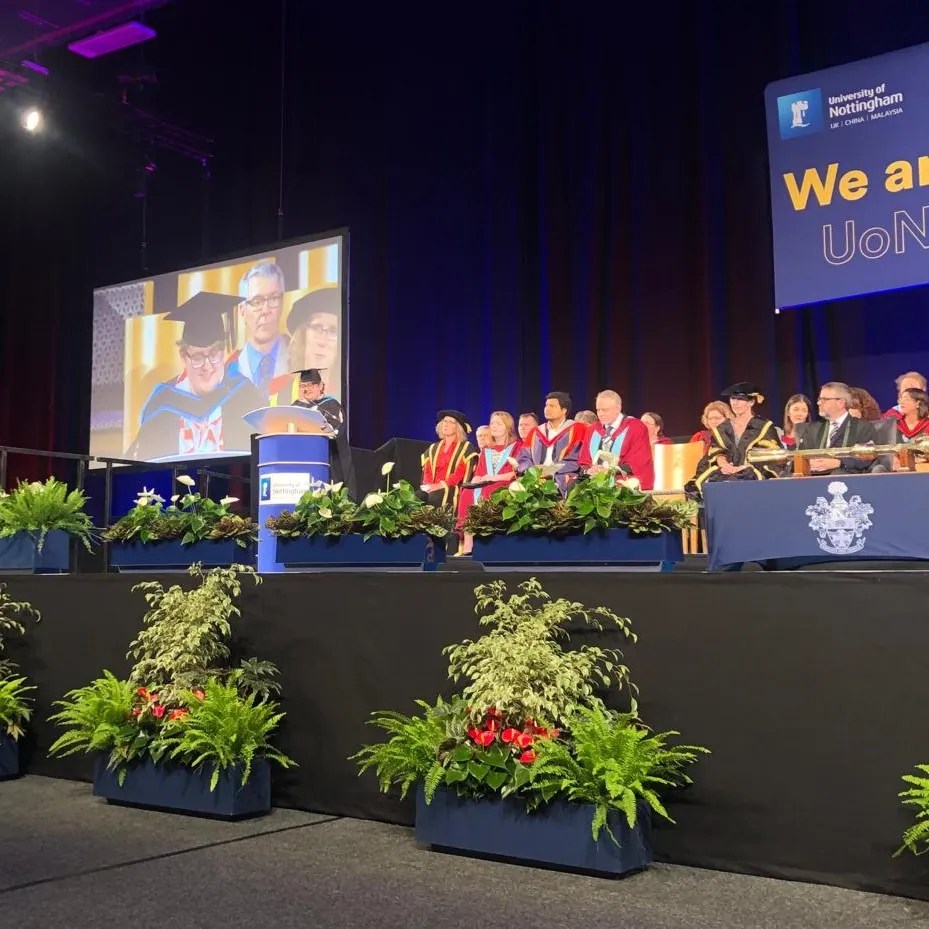
This year I was given an honorary award as an alumni of University of Nottingham, and gave a speech at the Sciences graduation ceremony. I thought I’d share the transcript of the speech.
I’m very honoured for the chance to talk to you all. Ten years ago, I collected my own degree in this very hall for a Masters in Natural Sciences. Looking back at that time, I was filled with excitement for my new life in the wider world to begin – and also very keen for a break from the long months of preparation for final exams.
It takes an immense amount of work, personal determination and mental focus to get to this day. You should all be very proud of the work that has brought you here. I can remember very clearly the long nights I spent struggling over algebra until the early hours of the morning.
As you embark on the next stage of your life, take a moment to really check in with who you are, now, in this moment. Think about the friendships you have formed, and the relationships you have established with your peers and mentors. Over the next few years, you might change and grow immensely. But those supportive relationships will remain with you.
In the last ten years, I have learnt so much about myself and the world. After studying Chemistry and Physics, I intended to find work in scientific research. However, one of my hobbies turned out to be unexpectedly beneficial. A novel I had written during my summer break ended up being sold to a publisher before I graduated. I walked this stage carrying a special secret, alongside my Natural Sciences degree: that I was soon to be a published author for a time travel story based in the physics I’d learnt during my course.
Initially, I planned to write for a ‘gap year’ and then jump back into the world of ‘real work’. But that gap year turned into two years, and then three, and now here I am, a decade later. I have written nine novels, as well as working in the writers room for Netflix’s TV show Heartstopper.
While I’m not the science researcher I intended to become, I do use my degree every day. As well as my writing, I run a climate activism group that encourages writers to include representations of positive climate solutions in their fiction. I also advise production companies and television networks on how to use real science in their projects.
The skills my degree taught me are invaluable as a freelance writer. The University of Nottingham gives its students so many opportunities to thrive. During my degree, I was given the chance to spend an exchange year at Bucknell University in America. Through that freedom and flexibility as a student, I developed the confidence and skills I needed to work proactively and independently; to seek out opportunities in areas that interested me. The encouragement I received here, to forge my own path with determination, is something that still sticks with me, years later. I am incredibly proud to be a Nottingham graduate.
At this juncture in your lives, I encourage you to consider what you value most. Do you want stability, or do you want a career where every day is different? Do you want to be challenged and surprised? Do you want to be in control of the twists and turns your career takes? Do you want to guide and inspire others?
The decisions you make over the next few years will set the course of your life. Choose now what kind of future you want to build. Take risks. Never stop hustling. Seek out work that you are passionate about. Build genuine connections based in mutual respect and integrity. If you are a pleasant, enthusiastic, reliable person, opportunities will come to you from the most unexpected of places.
The world of work can be overwhelming, tiring and stressful. But if you follow your heart, and carve out a niche that is distinctly, uniquely yours, you will thrive.
Congratulations on everything you’ve achieved so far. I cannot wait to see where the next decade takes you.
Thank you to the University of Nottingham for this great honour.
I grew up in fandom. BBC Merlin, Doctor Who and Teen Wolf are some which I’m willing to admit to – but I was never picky. I was always more interested in the fans themselves than the fandom’s chosen media property of interest. I loved digging into the dramas going on within a fan community.
If I caught a whiff of a Big Name Fan with thousands of followers whose Tumblr ask box was full of gossipy messages, I was there. I read every write-up I could find about people getting caught for ‘internet crimes’ like faking an emergency for crowdfunding money or using photoshop to create fanart ‘pencil sketches’. I would click dozens of links to the original fraudulent blogger’s account, following a rabbit hole of posts where they defended their crimes, devouring the comment threads debating the drama.
The stakes of fandom dramas are low-to-non-existent – someone might have to delete their account, maybe? or change usernames? – but there is little real-life impact from fan drama. But when lies or secrets are revealed in fandoms, it can be so explosive that whole communities rupture down the middle, never to recover. Things get intense very quickly.
From personal experience, I was using fandom to fill a void for the things I was lacking in real life. For close, intimate friendships; for queer kindred spirits; for a community that made me feel safe, accepted and understood. When you’re relying so deeply on a small group of people for those things, it’s no wonder that a controversy can get so heated.
When your favourite fan writer is revealed to be plagiarising paragraphs of their fics from novels, it doesn’t just leave you without fic to read. It destroys the foundations of your support mechanisms. The people you trusted most, who you confided in – maybe telling them things you would never share in real life – are no longer trustworthy.
That can feel like a life-or-death crisis point.
So, I wrote a novel where fandom drama is life-or-death, literally. What if your favourite fan blogger is involved in a crime? What if the lead actor on your favourite TV show is killed?
I thought that it would be the perfect way to investigate a murder – in this case, a fan girl who obsessively documents the movements of her favourite actor on the day he is arrested for murder.
Last Seen Online is told through her blog posts, as she investigates the personal lives of the male actors on a fictional TV show in an attempt to prove that they are secretly queer and dating. She goes viral when she goes to their address, and one of the men ends up dead. But who murdered him, and why? The commenters on her blog are hugely invested in finding out.
I wanted to explore how the internet can be used as a tool for investigating real-world crimes. Can a fandom collectively use their detail-oriented focus and intense knowledge of their subjects to solve a crime?
In real life, groups of vigilante detectives on the internet have managed to solve real life murder cases. For example, a female skeleton found in an Ohio river in 1975 was IDed as a missing girl by a Reddit user who worked to update police databases with missing records. An unidentified man who died in a car crash in Australia in 1995 was identified by a Reddit thread, who found his family based on his Grateful Dead t-shirt. Several podcasts investigating old cases have led to new arrests and convictions, such as Your Own Backyard and Serial.
That is a seriously impressive and admirable level of detective work, but it’s a rare occasion when social media frenzies help to solve crimes. Mostly, the internet just turns traumatic disasters into viral clickbait.
The internet also tends to see conspiracies which aren’t there. Were Harry and Louis from One Direction secretly dating? Or is Taylor Swift gay? When you consume a huge quantity of content created by a celebrity, you form a strong parasocial bond with them. Fans feel like they know their role models on a personal level. They have spent huge amounts of time, energy and resources on studying their heroes – from going to all their shows and watching all their ‘behind the scenes’ content, to more extreme activities like tracking their jet movements or hotel stays. They will analyse their social media posts and pictures taken inside their homes, looking for clues to their inner lives.
These are also, conveniently, very useful skills to have if you are trying to find a murderer, which made Last Seen Online a delightful novel to write. I tried to write a book for internet-savvy, internet-cautious readers, who know that you can’t accept what you’re told at face value if you want to survive online. It is filled with references to the fandom dramas I lived through from 2005-2015.
Born in 1992, I was one of the earliest generations to really grow up with the internet. For me, fandom spaces were a lifeline when my touch-starved teenage self desperately needed connection and community. I know how easy it can be to slip too far into an obsessive space where you’re investing an unhealthy amount of time in a fan space – I only survived the pandemic lockdowns by engaging in the torture and pleasure of the Supernatural fandom.
It can be a safe space to seek out comfort in times of crisis. But let me end with a message to my younger self: No, Taylor Swift is not gay. But you are.
This essay was originally shared on United by Pop.You can also read a recent interview I gave to the Nerd Daily.
Events
If you want to meet me, here are a few events I’m going to be appearing at:
Last week I appeared on a panel at the BBC’s Climate Creatives Conference, which aired online. You can watch it here.
The new season of Heartstopper was also released this week, which I work on as a story consultant. Jonathan Bailey played a classics historian, and you can find out mroe about his character in the Volume 5 hardback of Heartstopper, where he appears in a mini comic written by me and illustrated by Alice Oseman.
I just got back from a month long writing retreat in Europe – I went to Budapest, Vienna and Prague, and it’s so lovely, but a bit strange, being home again!
I’m diving right back into events, so if you want to see me, here’s where I’m going to be (online, Cheltenham, Norwich, Birmingham, Coventry, London and Nuneaton):


 Wren James